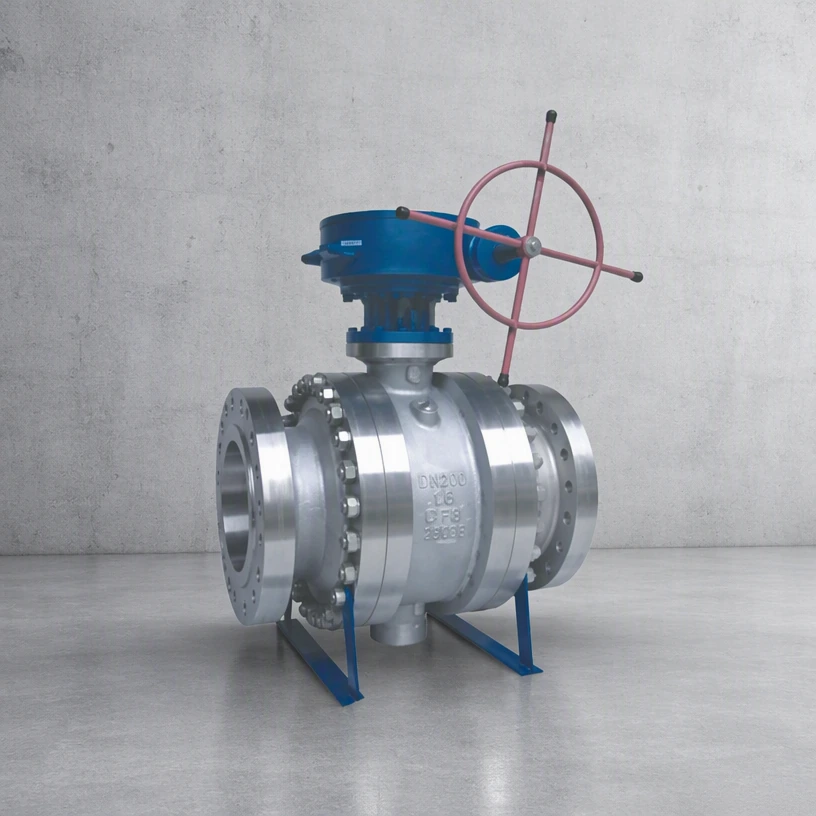
Q1. What is a trunnion mounted ball valve used for, and where is it used?
A1. A ball valve isolates or switches flow with a quarter turn of a bored ball. It is used wherever the valve is operated often or has to be operated quickly and visibly: on-off duty on water, oil, gas and chemicals, at the inlet and outlet of instruments and small pumps, on manifold and sampling points, on filling and emptying connections, and on gas lines where a tight seal matters. Compared with a gate valve the advantages are speed, a seal made by a seat that wipes itself as the ball turns, and no cavity in line with the flow. The limits come from the seat material: the polymer seats that give bubble-tight shut-off set a temperature ceiling, and the bore through the ball adds a small pressure loss that a full-bore design is used to avoid.
Q2. What body materials and seating arrangements can be specified?
A2. Carbon steel is standard for oil, gas and water; forged steel is used for small-bore and high-pressure classes where a cast body would be too thick; stainless (CF8 / CF8M) suits corrosive and clean service. Seat material follows the temperature and the medium: PTFE to about 180 °C, reinforced PTFE or PEEK higher, and metal-to-metal for abrasive media or high temperature. Two details worth stating in the enquiry are whether a fire-safe design is required (a metal back-up seat that holds after the soft insert is destroyed) and whether an anti-static device between ball, stem and body is needed, which is standard on gas service.
Q3. What should I watch during installation, operation and maintenance?
A3. Ball valves are quarter-turn devices and are meant to be worked fully open or fully closed; using one to throttle erodes the seat and, on a soft seat, heats it until it deforms. Leave the valve in the position it will spend its life in, and operate it periodically so the seat does not take a permanent set. On buried or extended-stem valves grease the stem bearings through the fittings provided, and on gas service check the cavity relief path. When the valve is opened after a long shutdown, open it slowly, because the pressure that has built up in the cavity releases suddenly.
Q4. Which standards is this valve designed and tested to?
A4. These valves are built to published standards rather than to a catalogue number. The pressure and temperature framework normally follows ASME B16.34; ASME B16.10 covers face-to-face dimensions and ASME B16.5 the flange drilling. The design reference follows the type: API 600 for bolted-bonnet steel gate, globe and check valves in the larger sizes, API 602 for the compact forged versions, API 608 for ball valves, API 609 for butterfly valves, and API 6D where the valve is intended for pipeline service. Pressure testing follows API 598. The certificate of conformity issued with a delivery states which standard and which revision each item was built and tested to, so the drawing should be read together with that certificate.
Q5. How is the valve pressure tested before delivery?
A5. Every valve is shell-tested and seat-tested before dispatch. The shell test is at 1.5 times the rated pressure at 38 °C with the valve partly open, proving the pressure boundary; the seat test is at 1.1 times with the valve closed, proving the closure. Holding time follows the standard and the size. Acceptance is normally quoted against ISO 5208: Rate A means no visible leakage, while lower rates permit a defined leakage over the test period. The rate that applies should be written into the specification — on gas, toxic or metered service Rate A is the usual requirement.
Q6. How do I select the right one for my line?
A6. Two questions decide most of the outcome. The first is what the valve has to do: isolate, regulate, prevent reverse flow or protect against overpressure — the four duties rarely overlap and each points at a different product. The second is what the line can accept in terms of pressure loss, installation length and headroom for the operator. Anything that cannot be answered from the line list should be marked as a question rather than assumed, because the assumptions are what come back as change orders.
Q7. How do I order, and what information is needed for a quotation?
A7. Give us the service conditions rather than only a model number: size, pressure rating, medium, temperature and connection. Where a standard applies, name it and the revision. Custom work is normal in this range — end connections, operator type, trim material and surface treatment are all specified per order.