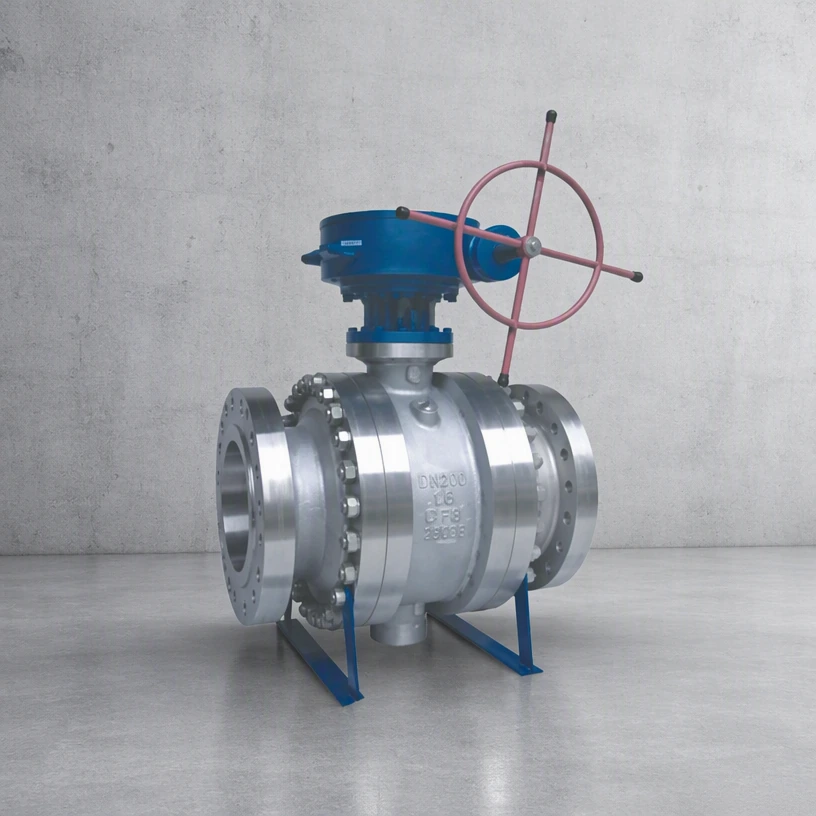
Q1. What is a stainless steel three-way ball valve used for, and where is it used?
A1. A ball valve isolates or switches flow with a quarter turn of a bored ball. It is used wherever the valve is operated often or has to be operated quickly and visibly: on-off duty on water, oil, gas and chemicals, at the inlet and outlet of instruments and small pumps, on manifold and sampling points, on filling and emptying connections, and on gas lines where a tight seal matters. Compared with a gate valve the advantages are speed, a seal made by a seat that wipes itself as the ball turns, and no cavity in line with the flow. The limits come from the seat material: the polymer seats that give bubble-tight shut-off set a temperature ceiling, and the bore through the ball adds a small pressure loss that a full-bore design is used to avoid. In stainless construction it is used on corrosive and clean services: acids and alkalis, food and pharmaceutical product lines, and demineralised or high-purity water.
Q2. What design variants are available, and how do I tell them apart?
A2. Two design families matter. A floating ball is pressed against the downstream seat by the line pressure itself; it is simple, seals well in the smaller sizes and is the usual choice up to about DN200. A trunnion-mounted ball is supported top and bottom in bearings so the seats are loaded by a spring rather than by the line, which is what allows large sizes and high pressure to be handled with a low operating torque. Body construction is one-piece, two-piece or three-piece, the choice being driven by whether the valve must be serviced in line. Port can be full bore or reduced, and the seat is either soft or metal.
Q3. How do I choose between austenitic and duplex stainless grades?
A3. Start from the medium rather than from a grade list. CF8 (304 type) is adequate for water, steam and mildly aggressive chemical service; CF8M (316 type) is the usual minimum where chlorides, dilute acids or urea are present. Above roughly 60 °C, chlorides become a stress-corrosion cracking risk for austenitic grades whatever the molybdenum content, and duplex stainless is the standard answer because it resists both cracking and pitting better. Put the medium, its concentration, the chloride level and the temperature into the enquiry — those four figures decide the grade, and a specification that says only ‘stainless steel’ leaves the choice open to whoever quotes it.
Q4. Which standards is this valve designed and tested to?
A4. These valves are built to published standards rather than to a catalogue number. The pressure and temperature framework normally follows ASME B16.34; ASME B16.10 covers face-to-face dimensions and ASME B16.5 the flange drilling. The design reference follows the type: API 600 for bolted-bonnet steel gate, globe and check valves in the larger sizes, API 602 for the compact forged versions, API 608 for ball valves, API 609 for butterfly valves, and API 6D where the valve is intended for pipeline service. Pressure testing follows API 598. The certificate of conformity issued with a delivery states which standard and which revision each item was built and tested to, so the drawing should be read together with that certificate.
Q5. How does it compare with the alternative valve types on the same line?
A5. The alternatives worth comparing are the ones that could do the same job at a different cost. A butterfly valve is lighter and cheaper as size grows and needs little space, but its disc sits in the flow and its seat is more easily damaged. A gate valve costs more at small sizes but holds tight more easily and gives an unobstructed bore when open. A ball valve gives quarter-turn operation and is better where the valve is cycled often. A globe valve is chosen only when some regulation is wanted, because it costs permanent pressure drop. A check valve is not an alternative to any of them — it prevents reverse flow and cannot isolate.
Q6. How do I select the right one for my line?
A6. Work through the operating envelope rather than the normal condition. The normal condition gives the size; the maximum and minimum give the material and the seat. The extremes that matter are the highest temperature, the highest differential the valve will be asked to close against, and the most corrosive or most abrasive the medium will ever be — including during cleaning and start-up, when the fluid is often not what the design assumed. A valve sized on the normal condition alone will be the one that fails first.
Q7. How do I order, and what information is needed for a quotation?
A7. Give us the service conditions rather than only a model number: size, pressure rating, medium, temperature and connection. Where a standard applies, name it and the revision. Custom work is normal in this range — end connections, operator type, trim material and surface treatment are all specified per order.