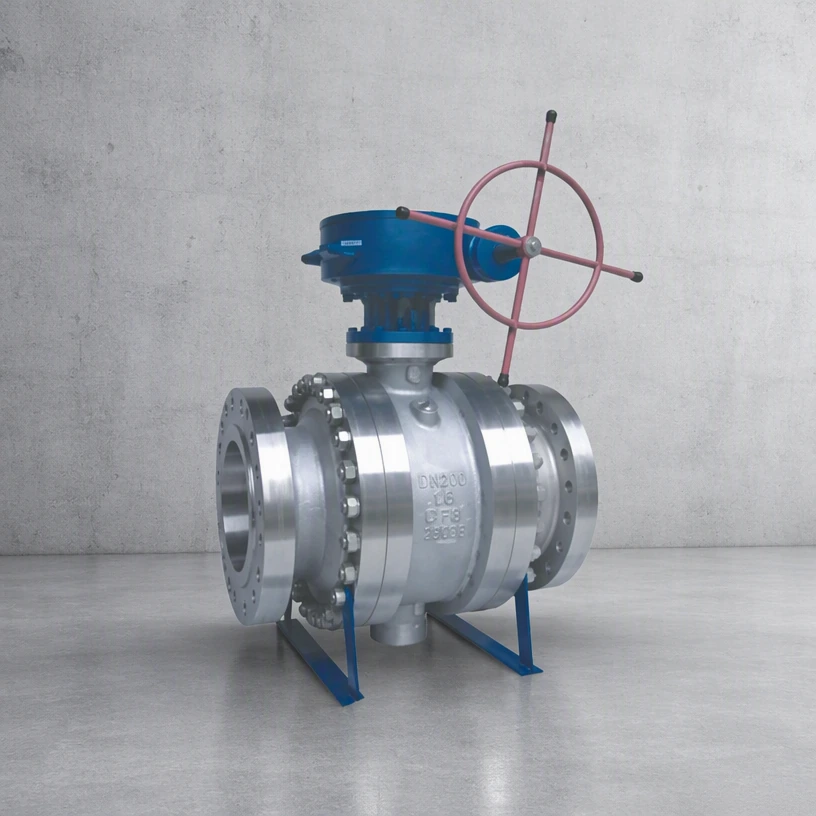
Q1. What is a worm gear ball valve used for, and where is it used?
A1. A ball valve isolates or switches flow with a quarter turn of a bored ball. It is used wherever the valve is operated often or has to be operated quickly and visibly: on-off duty on water, oil, gas and chemicals, at the inlet and outlet of instruments and small pumps, on manifold and sampling points, on filling and emptying connections, and on gas lines where a tight seal matters. Compared with a gate valve the advantages are speed, a seal made by a seat that wipes itself as the ball turns, and no cavity in line with the flow. The limits come from the seat material: the polymer seats that give bubble-tight shut-off set a temperature ceiling, and the bore through the ball adds a small pressure loss that a full-bore design is used to avoid.
Q2. What should I watch during installation, operation and maintenance?
A2. Ball valves are quarter-turn devices and are meant to be worked fully open or fully closed; using one to throttle erodes the seat and, on a soft seat, heats it until it deforms. Leave the valve in the position it will spend its life in, and operate it periodically so the seat does not take a permanent set. On buried or extended-stem valves grease the stem bearings through the fittings provided, and on gas service check the cavity relief path. When the valve is opened after a long shutdown, open it slowly, because the pressure that has built up in the cavity releases suddenly.
Q3. When is a gearbox the right answer instead of an actuator?
A3. A gearbox is the right answer when the problem is effort rather than control: a large valve that one person has to be able to operate, with no requirement to work it remotely or from a sequence. It is simple, needs no power supply and cannot fail in a way that leaves the valve in an undefined position. Move to an actuator when the valve has to be operated from a control room, worked on a schedule, or interlocked with other equipment. Note that if an actuator is fitted, the gearbox normally becomes redundant rather than complementary.
Q4. Which standards is this valve designed and tested to?
A4. These valves are built to published standards rather than to a catalogue number. The pressure and temperature framework normally follows ASME B16.34; ASME B16.10 covers face-to-face dimensions and ASME B16.5 the flange drilling. The design reference follows the type: API 600 for bolted-bonnet steel gate, globe and check valves in the larger sizes, API 602 for the compact forged versions, API 608 for ball valves, API 609 for butterfly valves, and API 6D where the valve is intended for pipeline service. Pressure testing follows API 598. The certificate of conformity issued with a delivery states which standard and which revision each item was built and tested to, so the drawing should be read together with that certificate.
Q5. How does it compare with the alternative valve types on the same line?
A5. Choose by duty first and by price second. Isolation over long periods with low loss points at a gate or a ball valve; frequent on–off points at a ball valve; flow regulation points at a globe or a control valve; tight shut-off on gas at a soft-seated ball; and space-constrained large lines point at a butterfly. The cost comparison only becomes meaningful once the duty is fixed, because the cheapest valve of the wrong type is the expensive one.
Q6. How do I select the right one for my line?
A6. Work through the operating envelope rather than the normal condition. The normal condition gives the size; the maximum and minimum give the material and the seat. The extremes that matter are the highest temperature, the highest differential the valve will be asked to close against, and the most corrosive or most abrasive the medium will ever be — including during cleaning and start-up, when the fluid is often not what the design assumed. A valve sized on the normal condition alone will be the one that fails first.
Q7. How do I order, and what information is needed for a quotation?
A7. Send the line size, pressure class, medium, working temperature and required connection. Add anything the line demands — sour service, low temperature, a pigging requirement, a control-room signal — and the quotation will come back with the material and seat selection confirmed rather than assumed. Non-standard sizes, alternative operators, trim material and coating can all be produced to order.