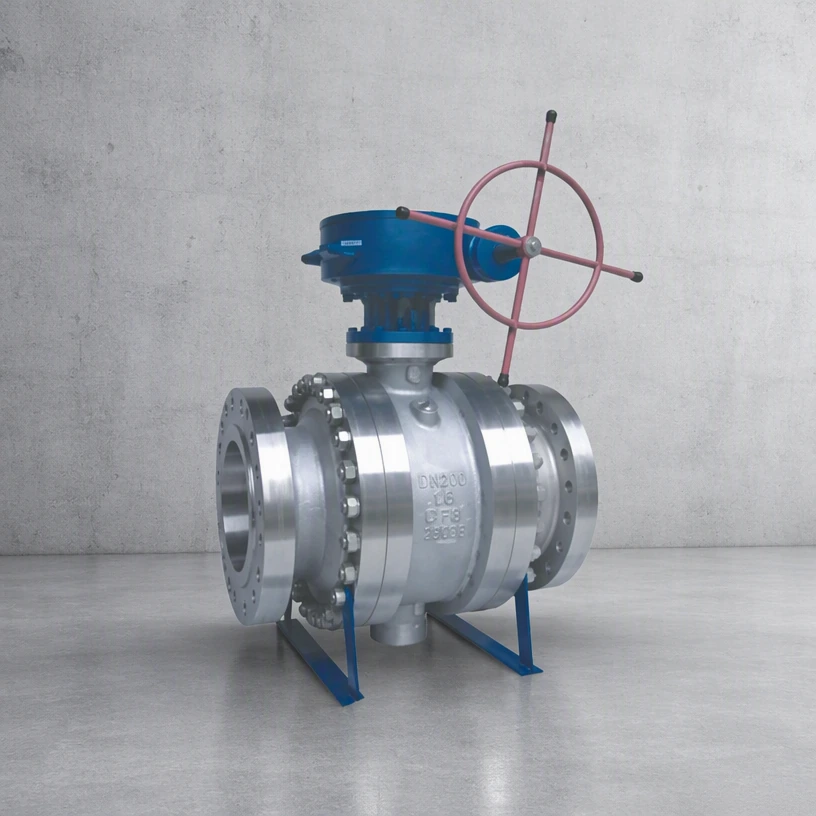
Q1. What is a sour service trunnion mounted ball valve used for, and where is it used?
A1. A ball valve isolates or switches flow with a quarter turn of a bored ball. It is used wherever the valve is operated often or has to be operated quickly and visibly: on-off duty on water, oil, gas and chemicals, at the inlet and outlet of instruments and small pumps, on manifold and sampling points, on filling and emptying connections, and on gas lines where a tight seal matters. Compared with a gate valve the advantages are speed, a seal made by a seat that wipes itself as the ball turns, and no cavity in line with the flow. The limits come from the seat material: the polymer seats that give bubble-tight shut-off set a temperature ceiling, and the bore through the ball adds a small pressure loss that a full-bore design is used to avoid.
Q2. What design variants are available, and how do I tell them apart?
A2. Two design families matter. A floating ball is pressed against the downstream seat by the line pressure itself; it is simple, seals well in the smaller sizes and is the usual choice up to about DN200. A trunnion-mounted ball is supported top and bottom in bearings so the seats are loaded by a spring rather than by the line, which is what allows large sizes and high pressure to be handled with a low operating torque. Body construction is one-piece, two-piece or three-piece, the choice being driven by whether the valve must be serviced in line. Port can be full bore or reduced, and the seat is either soft or metal.
Q3. What body materials and seating arrangements can be specified?
A3. Carbon steel is standard for oil, gas and water; forged steel is used for small-bore and high-pressure classes where a cast body would be too thick; stainless (CF8 / CF8M) suits corrosive and clean service. Seat material follows the temperature and the medium: PTFE to about 180 °C, reinforced PTFE or PEEK higher, and metal-to-metal for abrasive media or high temperature. Two details worth stating in the enquiry are whether a fire-safe design is required (a metal back-up seat that holds after the soft insert is destroyed) and whether an anti-static device between ball, stem and body is needed, which is standard on gas service.
Q4. How is the valve pressure tested before delivery?
A4. Two practical points are worth fixing before the order is placed: whether the seat test is carried out in both directions or only in the specified flow direction, and whether a test certificate with the recorded figures is required or a simple pass statement will do. On isolation valves for gas and hazardous media the recorded figures are normally asked for and filed with the maintenance record, because they are the baseline against which later leakage is judged.
Q5. What are the common failure modes, and how are they avoided?
A5. The failures seen in service are fairly consistent, and almost all of them are handling rather than design. Seat damage from particles trapped between the faces, usually caused by using the valve to throttle an abrasive medium. Gland leakage from packing that has aged or a stem that has been scored by over-tightening. Corrosion of the stem and the bonnet bolting where water sits. And seizure after years without operation. The countermeasures are the same in every case: keep the pipework clean before commissioning, work the valve through its full travel periodically, do not leave it part open, and inspect the packing whenever the line is down.
Q6. How do I select the right one for my line?
A6. Match the valve to the frequency of operation, because that is the variable most often left out. A valve worked twice a year can be a simple handwheel type; the same valve worked twice a day needs a different seat, a different stem finish and probably a gearbox; worked from a control room it needs an actuator with position feedback. The number of cycles also decides whether the seat should be soft or hard, and whether spare seats or a spare complete unit is the right thing to hold in stores.
Q7. How do I order, and what information is needed for a quotation?
A7. Send the line size, pressure class, medium, working temperature and required connection. Add anything the line demands — sour service, low temperature, a pigging requirement, a control-room signal — and the quotation will come back with the material and seat selection confirmed rather than assumed. Non-standard sizes, alternative operators, trim material and coating can all be produced to order.