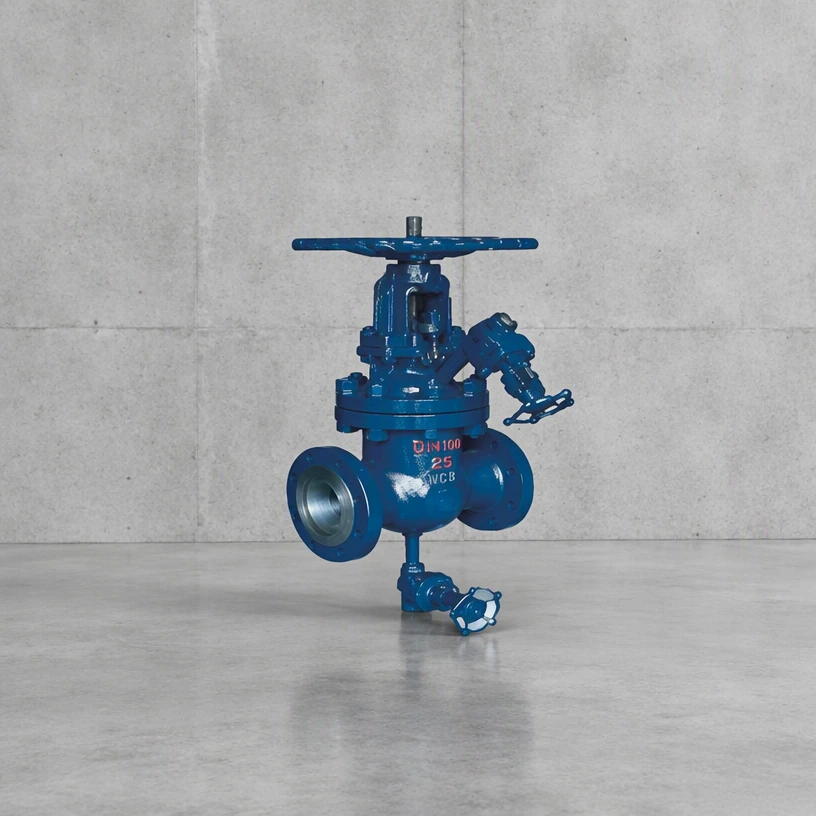
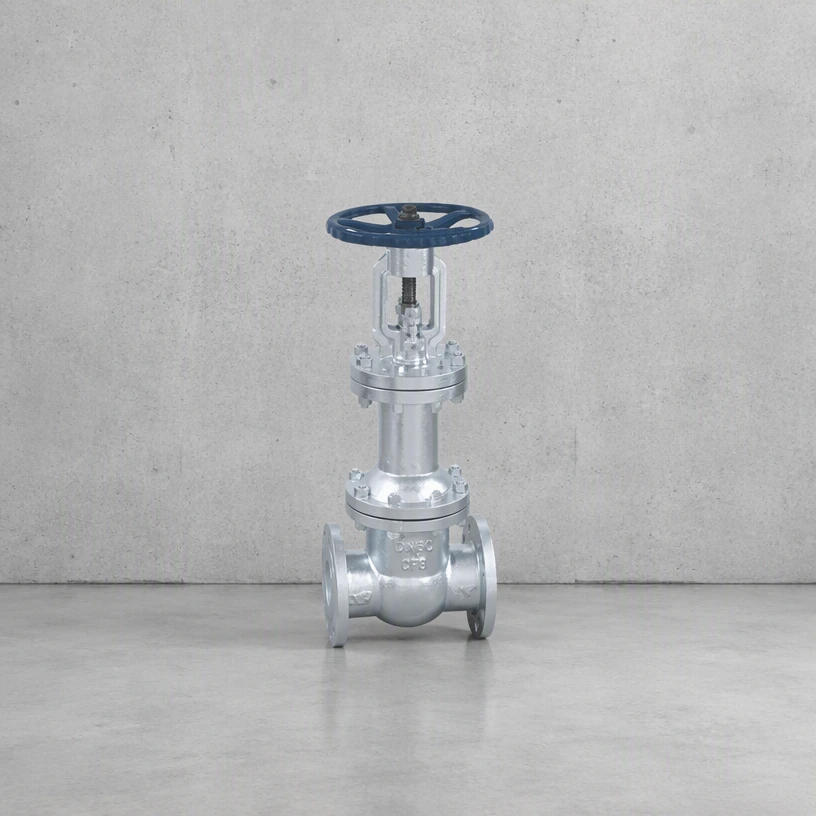
Q1. What is an ASME forged steel gate valve used for, and where is it used?
A1. A gate valve is an isolation valve: it lifts a gate out of the flow path, so it works between fully open and fully closed and is never used to regulate. It is the standard choice where a line has to be left open for long periods and then shut off tightly — water and waste-water mains, cooling-water and fire-water headers, plant steam and condensate headers, oil and gas gathering lines, and the block-valve position on either side of a pump or a control valve. Because the gate travels at right angles to the flow, the bore is almost straight through when the valve is open and the pressure loss is the lowest of any isolation valve. That combination — unobstructed bore plus tight shut-off — is the reason it is still the default on large lines. In forged construction it is used on small-bore high-pressure duty — steam and instrument lines, and services where a sound, radiographically clean body is required.
Q2. What should I watch during installation, operation and maintenance?
A2. Install the valve so that the medium does not accumulate in the bonnet — stem-down installation is avoided for that reason. Keep gate valves fully open or fully closed; holding one at part travel leaves the disc unsupported in the flow stream and erodes the seat. Operate buried or rarely used valves at least once a year, and keep the valve chamber clear of silt so that the operating key engages properly.
Q3. What is the difference between a forged body and a cast body?
A3. A forged body is formed from solid bar or billet under pressure, so the material is worked and its grain flows around the shape instead of being cast into it. There are no shrinkage cavities or gas pores, and the part can be examined volumetrically — radiographic or ultrasonic — and traced as a single piece of known origin. That is why forged bodies are used on small-bore high-pressure duty — steam and instrument lines, hydrogen and ammonia service, and the higher classes where casting quality is harder to assure in a thick wall. A casting is cheaper and allows a more complex internal shape and a larger bore, and in the common sizes at standard classes the quality is well controlled by the casting standard and by radiographic examination. The working rule is that small and thick-walled goes to forging, large and complex goes to casting.
Q4. How is the valve pressure tested before delivery?
A4. Two practical points are worth fixing before the order is placed: whether the seat test is carried out in both directions or only in the specified flow direction, and whether a test certificate with the recorded figures is required or a simple pass statement will do. On isolation valves for gas and hazardous media the recorded figures are normally asked for and filed with the maintenance record, because they are the baseline against which later leakage is judged.
Q5. What are the common failure modes, and how are they avoided?
A5. The failures seen in service are fairly consistent, and almost all of them are handling rather than design. Seat damage from particles trapped between the faces, usually caused by using the valve to throttle an abrasive medium. Gland leakage from packing that has aged or a stem that has been scored by over-tightening. Corrosion of the stem and the bonnet bolting where water sits. And seizure after years without operation. The countermeasures are the same in every case: keep the pipework clean before commissioning, work the valve through its full travel periodically, do not leave it part open, and inspect the packing whenever the line is down.
Q6. How do I select the right one for my line?
A6. Two questions decide most of the outcome. The first is what the valve has to do: isolate, regulate, prevent reverse flow or protect against overpressure — the four duties rarely overlap and each points at a different product. The second is what the line can accept in terms of pressure loss, installation length and headroom for the operator. Anything that cannot be answered from the line list should be marked as a question rather than assumed, because the assumptions are what come back as change orders.
Q7. How do I order, and what information is needed for a quotation?
A7. Give us the service conditions rather than only a model number: size, pressure rating, medium, temperature and connection. Where a standard applies, name it and the revision. Custom work is normal in this range — end connections, operator type, trim material and surface treatment are all specified per order.