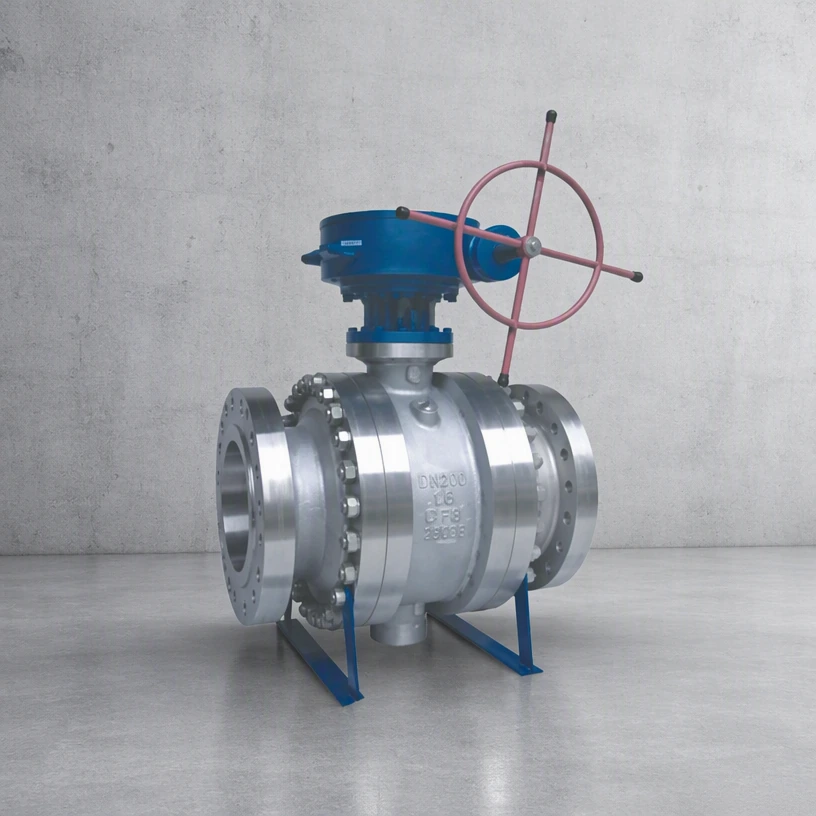
Q1. What is a pneumatic actuated flanged ball valve used for, and where is it used?
A1. A ball valve isolates or switches flow with a quarter turn of a bored ball. It is used wherever the valve is operated often or has to be operated quickly and visibly: on-off duty on water, oil, gas and chemicals, at the inlet and outlet of instruments and small pumps, on manifold and sampling points, on filling and emptying connections, and on gas lines where a tight seal matters. Compared with a gate valve the advantages are speed, a seal made by a seat that wipes itself as the ball turns, and no cavity in line with the flow. The limits come from the seat material: the polymer seats that give bubble-tight shut-off set a temperature ceiling, and the bore through the ball adds a small pressure loss that a full-bore design is used to avoid. With a pneumatic actuator it goes on lines that are operated from a control room, by an interlock, or in batches on a timed cycle rather than by hand.
Q2. What should I watch during installation, operation and maintenance?
A2. Ball valves are quarter-turn devices and are meant to be worked fully open or fully closed; using one to throttle erodes the seat and, on a soft seat, heats it until it deforms. Leave the valve in the position it will spend its life in, and operate it periodically so the seat does not take a permanent set. On buried or extended-stem valves grease the stem bearings through the fittings provided, and on gas service check the cavity relief path. When the valve is opened after a long shutdown, open it slowly, because the pressure that has built up in the cavity releases suddenly.
Q3. What does an air actuator give that a handwheel cannot?
A3. Powered operation brings four things a handwheel cannot. Speed — an air actuator strokes the valve in seconds, which is what trip and interlock logic needs. Repeatability — the valve reaches the same position every time, so the seat is loaded consistently instead of by however hard the operator turned. Remote and automatic operation — the valve can sit inside a sequence or be worked from a control room, which matters on unattended stations. Safety in hazardous areas — air produces no spark and needs no flameproof enclosure, which is often why compressed air is preferred to electricity on gas and petrochemical sites. What it does not do is remove the need to define the failure position: state whether the valve must fail closed, fail open or stay in place when the supply is lost.
Q4. Which standards is this valve designed and tested to?
A4. Where a customer specifies a different standard — DIN, EN, GB or a client specification — it can be worked to, but it should be named at enquiry stage, because it changes dimensions, the material list and the test acceptance at the same time. Two details are worth settling early because they are easy to leave to assumption: the revision of the standard that applies, and which edition of the pressure–temperature tables is being used for the rating.
Q5. How does it compare with the alternative valve types on the same line?
A5. The alternatives worth comparing are the ones that could do the same job at a different cost. A butterfly valve is lighter and cheaper as size grows and needs little space, but its disc sits in the flow and its seat is more easily damaged. A gate valve costs more at small sizes but holds tight more easily and gives an unobstructed bore when open. A ball valve gives quarter-turn operation and is better where the valve is cycled often. A globe valve is chosen only when some regulation is wanted, because it costs permanent pressure drop. A check valve is not an alternative to any of them — it prevents reverse flow and cannot isolate.
Q6. How do I select the right one for my line?
A6. Work through the operating envelope rather than the normal condition. The normal condition gives the size; the maximum and minimum give the material and the seat. The extremes that matter are the highest temperature, the highest differential the valve will be asked to close against, and the most corrosive or most abrasive the medium will ever be — including during cleaning and start-up, when the fluid is often not what the design assumed. A valve sized on the normal condition alone will be the one that fails first.
Q7. How do I order, and what information is needed for a quotation?
A7. Ordering starts from the line list: tag number, size, class, medium, temperature, connection and operating method. Send that and we will confirm material and seat selection against the medium, flag anything that is likely to cause trouble on site, and quote accordingly. Special sizes, operators and materials are produced to order.