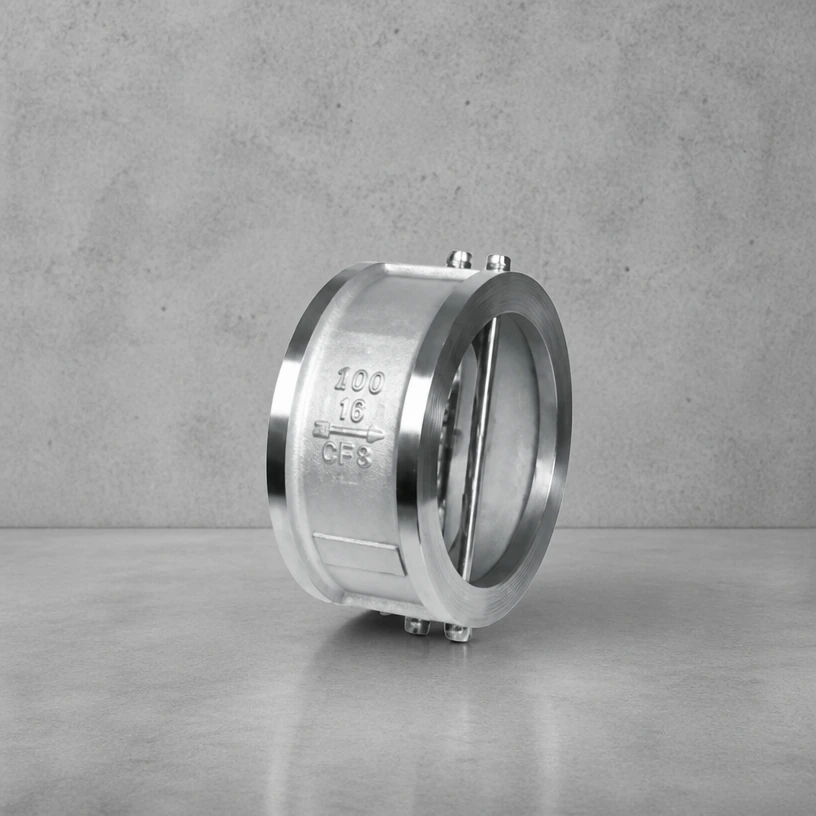
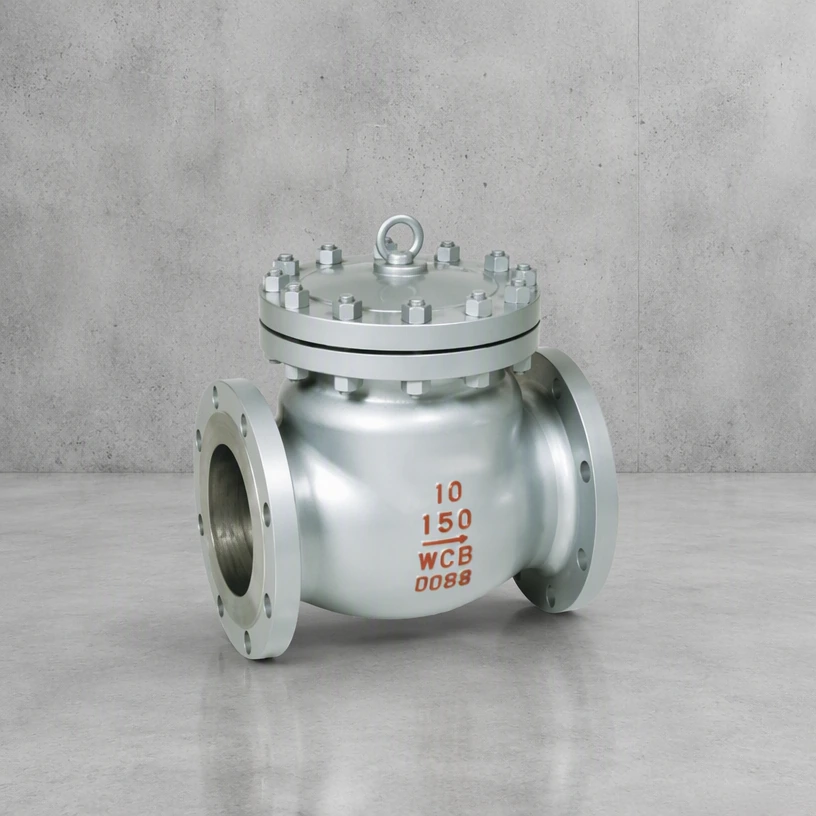
Q1. What is a short pattern check valve used for, and where is it used?
A1. A check valve prevents reverse flow and does nothing else — it is not an isolating valve and cannot be used to shut a line down. It is fitted wherever backflow would damage equipment, contaminate a line or drain a header: at the discharge of every pump, on compressor and blower outlets, on the suction of a pump fed from a pressurised source, downstream of a meter, at the outlet of a boiler feed line, and on any branch that must not drain back. It works automatically, with no operator and no external signal, so it has to be chosen so that it neither chatters at low flow nor slams when the flow reverses. Because it is a passive item with no adjustment once it is in the line, its closing behaviour is what decides whether it protects the line or damages it. In the wafer pattern it is used on lines inside a plant where space is tight and the pipe is fully supported, rather than at the end of an unsupported run.
Q2. What body materials and seating arrangements can be specified?
A2. Body material follows the line: cast iron and ductile iron for water, carbon steel (WCB) for steam and oil, forged steel for small-bore high-pressure service, and CF8 / CF8M for corrosive duties. The trim is where the service decides: 13Cr for steam and water, hard-faced disc and seat for high cycling or abrasive service, and soft-seated designs where the valve must be bubble-tight on gas or on metered lines. Valve springs are selected for the cracking pressure the line allows — a spring stiff enough to close quickly can also cost noticeable pressure drop.
Q3. What are the advantages and the limits of a wafer body?
A3. A wafer body is clamped between two pipe flanges and has almost no face-to-face length, so it takes very little space, weighs less than a flanged equivalent and costs less because it uses less material. The limits follow from that same fact. The body is not stiff in bending, so the two flanges have to stay aligned and both must be present; the valve cannot be installed at the free end of a line without a mating flange; and the pipe flanges carry whatever bending the line imposes. It is therefore used on well-supported lines inside a plant rather than on long unsupported runs, and on lines where the joint does not have to be opened at the valve for maintenance without a second flange to work against.
Q4. What should I watch during installation, operation and maintenance?
A4. Orientation rules differ by type and must be followed: a swing check needs a horizontal line with the hinge above the flow, a lift check needs the flow to lift the disc against gravity, and a dual-plate check can go in vertical or horizontal pipe but needs a straight run either side. A check valve is not an isolation valve — it does not replace a gate or ball valve for maintenance, and it should never be the only barrier against reverse flow on a line where backflow would be dangerous. On pumps, fit the check downstream of the isolation valve, not between it and the pump.
Q5. How does it compare with the alternative valve types on the same line?
A5. The alternatives worth comparing are the ones that could do the same job at a different cost. A butterfly valve is lighter and cheaper as size grows and needs little space, but its disc sits in the flow and its seat is more easily damaged. A gate valve costs more at small sizes but holds tight more easily and gives an unobstructed bore when open. A ball valve gives quarter-turn operation and is better where the valve is cycled often. A globe valve is chosen only when some regulation is wanted, because it costs permanent pressure drop. A check valve is not an alternative to any of them — it prevents reverse flow and cannot isolate.
Q6. How do I select the right one for my line?
A6. State the standard you want the valve built to, and the revision, rather than assuming one. A valve can be built to ASME, DIN, EN, GB or a client specification, and the choice changes face-to-face dimensions, flange drilling, the material list and the test acceptance at the same time — so it cannot be settled after the order. Where no standard is named, say which dimension is critical on your line: the face-to-face length where space is tight, or the flange drilling where the valve must bolt up to an existing flange.
Q7. How do I order, and what information is needed for a quotation?
A7. Ordering starts from the line list: tag number, size, class, medium, temperature, connection and operating method. Send that and we will confirm material and seat selection against the medium, flag anything that is likely to cause trouble on site, and quote accordingly. Special sizes, operators and materials are produced to order.