Q1. What is a forged steel flanged check valve used for, and where is it used?
A1. A check valve prevents reverse flow and does nothing else — it is not an isolating valve and cannot be used to shut a line down. It is fitted wherever backflow would damage equipment, contaminate a line or drain a header: at the discharge of every pump, on compressor and blower outlets, on the suction of a pump fed from a pressurised source, downstream of a meter, at the outlet of a boiler feed line, and on any branch that must not drain back. It works automatically, with no operator and no external signal, so it has to be chosen so that it neither chatters at low flow nor slams when the flow reverses. Because it is a passive item with no adjustment once it is in the line, its closing behaviour is what decides whether it protects the line or damages it. In forged construction it is used on small-bore high-pressure duty — steam and instrument lines, and services where a sound, radiographically clean body is required.
Q2. What design variants are available, and how do I tell them apart?
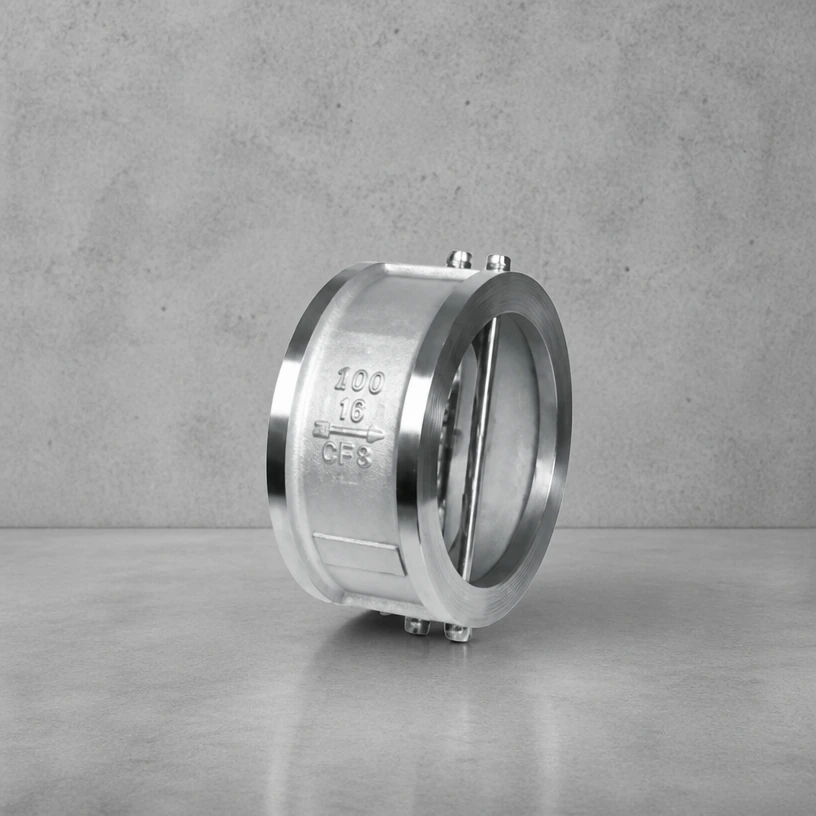
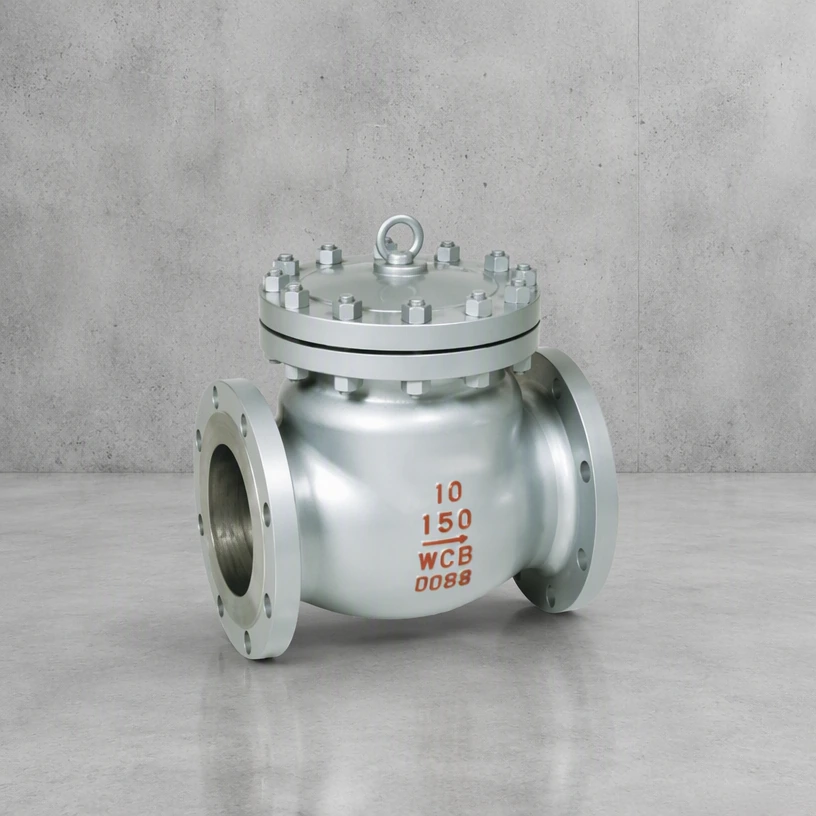
A2. The type is chosen from how much space is available and how fast the flow reverses. A swing check has a hinged disc and is the most common on water and steam mains, but it needs a long installation length and its disc can slam. A dual-plate (wafer) check puts two spring-loaded half discs in a short body, which suits tight spaces and reduces slam. A lift check guides the disc vertically and is used on high-pressure small-bore lines and where the flow is always in one direction. A tilting-disc check is the answer on large compressor and pump discharges, because the disc closes before the flow has fully reversed. Nozzle or axial checks use a spring-loaded ring around the axis and are chosen where the response has to be very fast.
Q3. What is the difference between a forged body and a cast body?
A3. A forged body is formed from solid bar or billet under pressure, so the material is worked and its grain flows around the shape instead of being cast into it. There are no shrinkage cavities or gas pores, and the part can be examined volumetrically — radiographic or ultrasonic — and traced as a single piece of known origin. That is why forged bodies are used on small-bore high-pressure duty — steam and instrument lines, hydrogen and ammonia service, and the higher classes where casting quality is harder to assure in a thick wall. A casting is cheaper and allows a more complex internal shape and a larger bore, and in the common sizes at standard classes the quality is well controlled by the casting standard and by radiographic examination. The working rule is that small and thick-walled goes to forging, large and complex goes to casting.
Q4. Which standards is this valve designed and tested to?
A4. These valves are built to published standards rather than to a catalogue number. The pressure and temperature framework normally follows ASME B16.34; ASME B16.10 covers face-to-face dimensions and ASME B16.5 the flange drilling. The design reference follows the type: API 600 for bolted-bonnet steel gate, globe and check valves in the larger sizes, API 602 for the compact forged versions, API 608 for ball valves, API 609 for butterfly valves, and API 6D where the valve is intended for pipeline service. Pressure testing follows API 598. The certificate of conformity issued with a delivery states which standard and which revision each item was built and tested to, so the drawing should be read together with that certificate.
Q5. What are the common failure modes, and how are they avoided?
A5. The failures seen in service are fairly consistent, and almost all of them are handling rather than design. Seat damage from particles trapped between the faces, usually caused by using the valve to throttle an abrasive medium. Gland leakage from packing that has aged or a stem that has been scored by over-tightening. Corrosion of the stem and the bonnet bolting where water sits. And seizure after years without operation. The countermeasures are the same in every case: keep the pipework clean before commissioning, work the valve through its full travel periodically, do not leave it part open, and inspect the packing whenever the line is down.
Q6. How do I select the right one for my line?
A6. State the standard you want the valve built to, and the revision, rather than assuming one. A valve can be built to ASME, DIN, EN, GB or a client specification, and the choice changes face-to-face dimensions, flange drilling, the material list and the test acceptance at the same time — so it cannot be settled after the order. Where no standard is named, say which dimension is critical on your line: the face-to-face length where space is tight, or the flange drilling where the valve must bolt up to an existing flange.
Q7. How do I order, and what information is needed for a quotation?
A7. Give us the service conditions rather than only a model number: size, pressure rating, medium, temperature and connection. Where a standard applies, name it and the revision. Custom work is normal in this range — end connections, operator type, trim material and surface treatment are all specified per order.