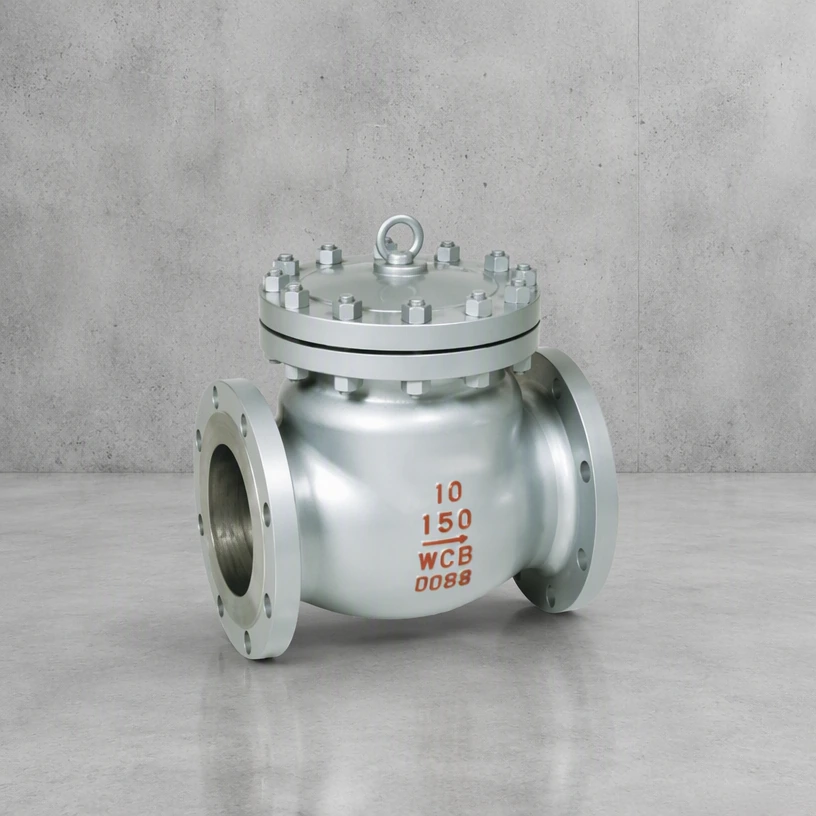
Q1. What is an ASME dual plate check valve used for, and where is it used?
A1. A check valve prevents reverse flow and does nothing else — it is not an isolating valve and cannot be used to shut a line down. It is fitted wherever backflow would damage equipment, contaminate a line or drain a header: at the discharge of every pump, on compressor and blower outlets, on the suction of a pump fed from a pressurised source, downstream of a meter, at the outlet of a boiler feed line, and on any branch that must not drain back. It works automatically, with no operator and no external signal, so it has to be chosen so that it neither chatters at low flow nor slams when the flow reverses. Because it is a passive item with no adjustment once it is in the line, its closing behaviour is what decides whether it protects the line or damages it.
Q2. What should I watch during installation, operation and maintenance?
A2. Orientation rules differ by type and must be followed: a swing check needs a horizontal line with the hinge above the flow, a lift check needs the flow to lift the disc against gravity, and a dual-plate check can go in vertical or horizontal pipe but needs a straight run either side. A check valve is not an isolation valve — it does not replace a gate or ball valve for maintenance, and it should never be the only barrier against reverse flow on a line where backflow would be dangerous. On pumps, fit the check downstream of the isolation valve, not between it and the pump.
Q3. Which standards is this valve designed and tested to?
A3. Where a customer specifies a different standard — DIN, EN, GB or a client specification — it can be worked to, but it should be named at enquiry stage, because it changes dimensions, the material list and the test acceptance at the same time. Two details are worth settling early because they are easy to leave to assumption: the revision of the standard that applies, and which edition of the pressure–temperature tables is being used for the rating.
Q4. How is the valve pressure tested before delivery?
A4. Every valve is shell-tested and seat-tested before dispatch. The shell test is at 1.5 times the rated pressure at 38 °C with the valve partly open, proving the pressure boundary; the seat test is at 1.1 times with the valve closed, proving the closure. Holding time follows the standard and the size. Acceptance is normally quoted against ISO 5208: Rate A means no visible leakage, while lower rates permit a defined leakage over the test period. The rate that applies should be written into the specification — on gas, toxic or metered service Rate A is the usual requirement.
Q5. How does it compare with the alternative valve types on the same line?
A5. The alternatives worth comparing are the ones that could do the same job at a different cost. A butterfly valve is lighter and cheaper as size grows and needs little space, but its disc sits in the flow and its seat is more easily damaged. A gate valve costs more at small sizes but holds tight more easily and gives an unobstructed bore when open. A ball valve gives quarter-turn operation and is better where the valve is cycled often. A globe valve is chosen only when some regulation is wanted, because it costs permanent pressure drop. A check valve is not an alternative to any of them — it prevents reverse flow and cannot isolate.
Q6. How do I select the right one for my line?
A6. Selection starts from the service, not from the catalogue. Fix the medium and its concentration first, because that decides the body material and the seating. Then the design pressure and the design temperature together, since the allowable pressure at temperature is lower than the cold rating and it is the hot figure that governs. Then the size, the connection, and how often the valve will be operated, which is what decides between a handwheel, a gearbox and an actuator. Bring those five answers to the enquiry and the rest of the selection follows from them.
Q7. How do I order, and what information is needed for a quotation?
A7. Send the line size, pressure class, medium, working temperature and required connection. Add anything the line demands — sour service, low temperature, a pigging requirement, a control-room signal — and the quotation will come back with the material and seat selection confirmed rather than assumed. Non-standard sizes, alternative operators, trim material and coating can all be produced to order.