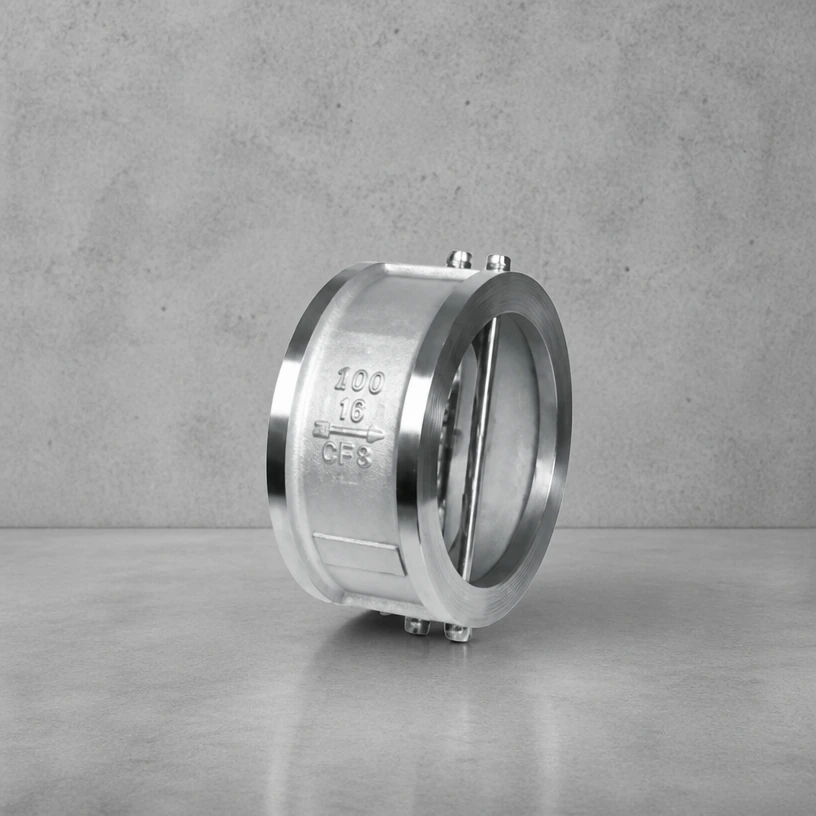
Q1. What is an ASME cast steel check valve used for, and where is it used?
A1. A check valve prevents reverse flow and does nothing else — it is not an isolating valve and cannot be used to shut a line down. It is fitted wherever backflow would damage equipment, contaminate a line or drain a header: at the discharge of every pump, on compressor and blower outlets, on the suction of a pump fed from a pressurised source, downstream of a meter, at the outlet of a boiler feed line, and on any branch that must not drain back. It works automatically, with no operator and no external signal, so it has to be chosen so that it neither chatters at low flow nor slams when the flow reverses. Because it is a passive item with no adjustment once it is in the line, its closing behaviour is what decides whether it protects the line or damages it.
Q2. What design variants are available, and how do I tell them apart?
A2. The type is chosen from how much space is available and how fast the flow reverses. A swing check has a hinged disc and is the most common on water and steam mains, but it needs a long installation length and its disc can slam. A dual-plate (wafer) check puts two spring-loaded half discs in a short body, which suits tight spaces and reduces slam. A lift check guides the disc vertically and is used on high-pressure small-bore lines and where the flow is always in one direction. A tilting-disc check is the answer on large compressor and pump discharges, because the disc closes before the flow has fully reversed. Nozzle or axial checks use a spring-loaded ring around the axis and are chosen where the response has to be very fast.
Q3. What body materials and seating arrangements can be specified?
A3. Body material follows the line: cast iron and ductile iron for water, carbon steel (WCB) for steam and oil, forged steel for small-bore high-pressure service, and CF8 / CF8M for corrosive duties. The trim is where the service decides: 13Cr for steam and water, hard-faced disc and seat for high cycling or abrasive service, and soft-seated designs where the valve must be bubble-tight on gas or on metered lines. Valve springs are selected for the cracking pressure the line allows — a spring stiff enough to close quickly can also cost noticeable pressure drop.
Q4. What should I watch during installation, operation and maintenance?
A4. Orientation rules differ by type and must be followed: a swing check needs a horizontal line with the hinge above the flow, a lift check needs the flow to lift the disc against gravity, and a dual-plate check can go in vertical or horizontal pipe but needs a straight run either side. A check valve is not an isolation valve — it does not replace a gate or ball valve for maintenance, and it should never be the only barrier against reverse flow on a line where backflow would be dangerous. On pumps, fit the check downstream of the isolation valve, not between it and the pump.
Q5. How does it compare with the alternative valve types on the same line?
A5. Choose by duty first and by price second. Isolation over long periods with low loss points at a gate or a ball valve; frequent on–off points at a ball valve; flow regulation points at a globe or a control valve; tight shut-off on gas at a soft-seated ball; and space-constrained large lines point at a butterfly. The cost comparison only becomes meaningful once the duty is fixed, because the cheapest valve of the wrong type is the expensive one.
Q6. How do I select the right one for my line?
A6. Match the valve to the frequency of operation, because that is the variable most often left out. A valve worked twice a year can be a simple handwheel type; the same valve worked twice a day needs a different seat, a different stem finish and probably a gearbox; worked from a control room it needs an actuator with position feedback. The number of cycles also decides whether the seat should be soft or hard, and whether spare seats or a spare complete unit is the right thing to hold in stores.
Q7. How do I order, and what information is needed for a quotation?
A7. Give us the service conditions rather than only a model number: size, pressure rating, medium, temperature and connection. Where a standard applies, name it and the revision. Custom work is normal in this range — end connections, operator type, trim material and surface treatment are all specified per order.