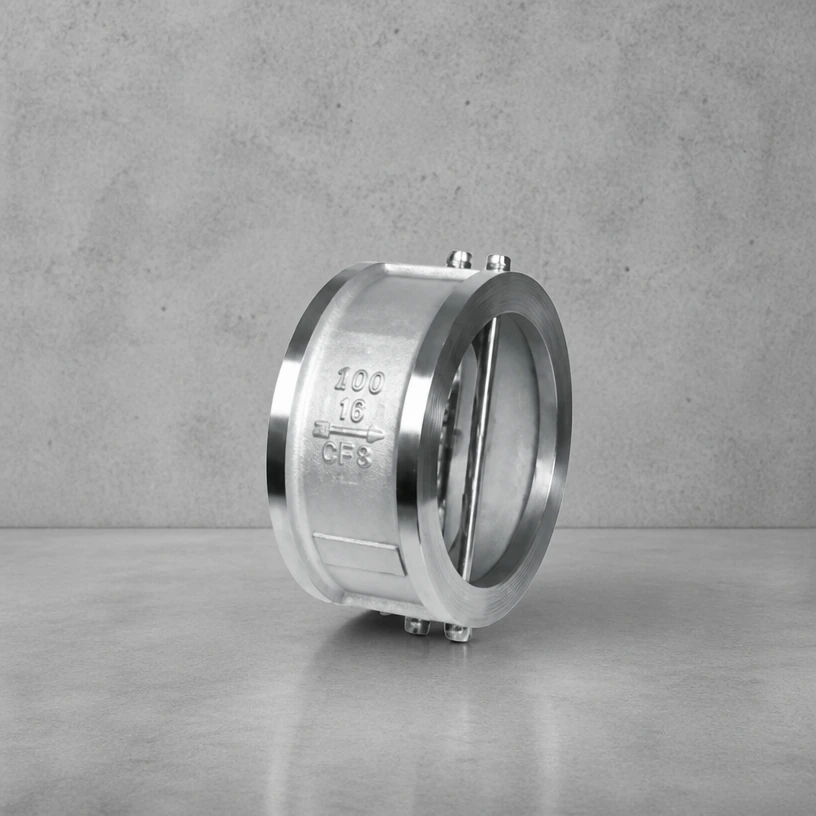
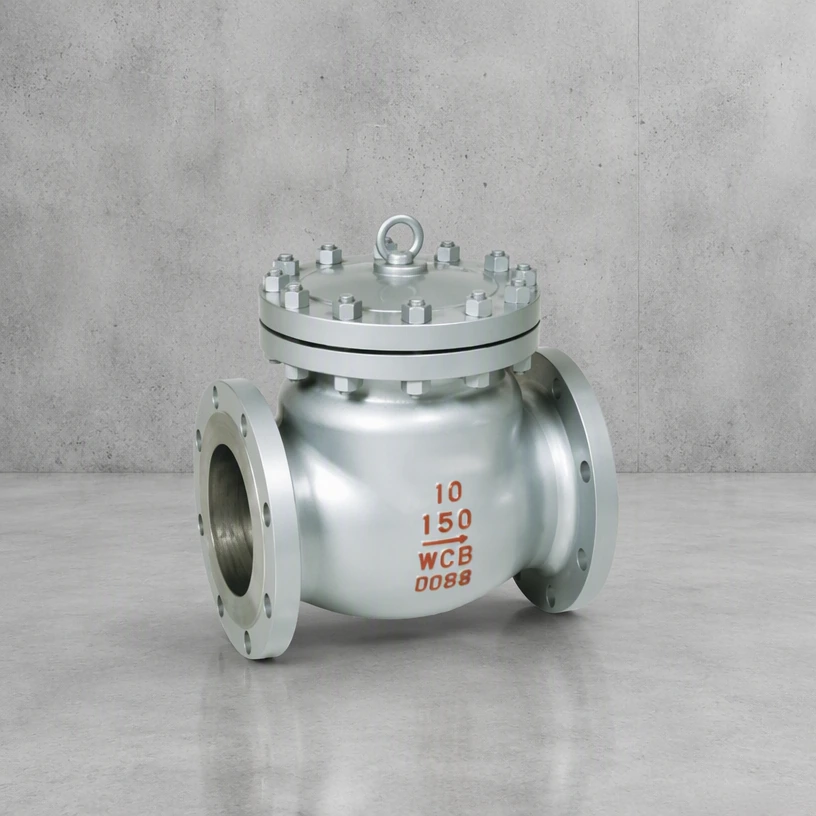
Q1. What is a stainless steel vertical check valve used for, and where is it used?
A1. A check valve prevents reverse flow and does nothing else — it is not an isolating valve and cannot be used to shut a line down. It is fitted wherever backflow would damage equipment, contaminate a line or drain a header: at the discharge of every pump, on compressor and blower outlets, on the suction of a pump fed from a pressurised source, downstream of a meter, at the outlet of a boiler feed line, and on any branch that must not drain back. It works automatically, with no operator and no external signal, so it has to be chosen so that it neither chatters at low flow nor slams when the flow reverses. Because it is a passive item with no adjustment once it is in the line, its closing behaviour is what decides whether it protects the line or damages it. In stainless construction it is used on corrosive and clean services: acids and alkalis, food and pharmaceutical product lines, and demineralised or high-purity water.
Q2. How is the valve pressure tested before delivery?
A2. Two practical points are worth fixing before the order is placed: whether the seat test is carried out in both directions or only in the specified flow direction, and whether a test certificate with the recorded figures is required or a simple pass statement will do. On isolation valves for gas and hazardous media the recorded figures are normally asked for and filed with the maintenance record, because they are the baseline against which later leakage is judged.
Q3. How do I choose between austenitic and duplex stainless grades?
A3. Start from the medium rather than from a grade list. CF8 (304 type) is adequate for water, steam and mildly aggressive chemical service; CF8M (316 type) is the usual minimum where chlorides, dilute acids or urea are present. Above roughly 60 °C, chlorides become a stress-corrosion cracking risk for austenitic grades whatever the molybdenum content, and duplex stainless is the standard answer because it resists both cracking and pitting better. Put the medium, its concentration, the chloride level and the temperature into the enquiry — those four figures decide the grade, and a specification that says only ‘stainless steel’ leaves the choice open to whoever quotes it.
Q4. How does it compare with the alternative valve types on the same line?
A4. The alternatives worth comparing are the ones that could do the same job at a different cost. A butterfly valve is lighter and cheaper as size grows and needs little space, but its disc sits in the flow and its seat is more easily damaged. A gate valve costs more at small sizes but holds tight more easily and gives an unobstructed bore when open. A ball valve gives quarter-turn operation and is better where the valve is cycled often. A globe valve is chosen only when some regulation is wanted, because it costs permanent pressure drop. A check valve is not an alternative to any of them — it prevents reverse flow and cannot isolate.
Q5. What are the common failure modes, and how are they avoided?
A5. A valve that fails early usually fails for one of four reasons: it was selected on the normal condition and then met the extreme one, it was installed against the flow arrow, it was used for a duty it was never designed for such as throttling or as the sole isolation point, or it was commissioned without the pipework being cleaned. Only the first of those is a selection issue; the other three are found on site, which is why the installation checks matter as much as the specification.
Q6. How do I select the right one for my line?
A6. Two questions decide most of the outcome. The first is what the valve has to do: isolate, regulate, prevent reverse flow or protect against overpressure — the four duties rarely overlap and each points at a different product. The second is what the line can accept in terms of pressure loss, installation length and headroom for the operator. Anything that cannot be answered from the line list should be marked as a question rather than assumed, because the assumptions are what come back as change orders.
Q7. How do I order, and what information is needed for a quotation?
A7. Ordering starts from the line list: tag number, size, class, medium, temperature, connection and operating method. Send that and we will confirm material and seat selection against the medium, flag anything that is likely to cause trouble on site, and quote accordingly. Special sizes, operators and materials are produced to order.