Q1. What is a foot valve used for, and where is it used?
A1. A check valve prevents reverse flow and does nothing else — it is not an isolating valve and cannot be used to shut a line down. It is fitted wherever backflow would damage equipment, contaminate a line or drain a header: at the discharge of every pump, on compressor and blower outlets, on the suction of a pump fed from a pressurised source, downstream of a meter, at the outlet of a boiler feed line, and on any branch that must not drain back. It works automatically, with no operator and no external signal, so it has to be chosen so that it neither chatters at low flow nor slams when the flow reverses. Because it is a passive item with no adjustment once it is in the line, its closing behaviour is what decides whether it protects the line or damages it.
Q2. What design variants are available, and how do I tell them apart?
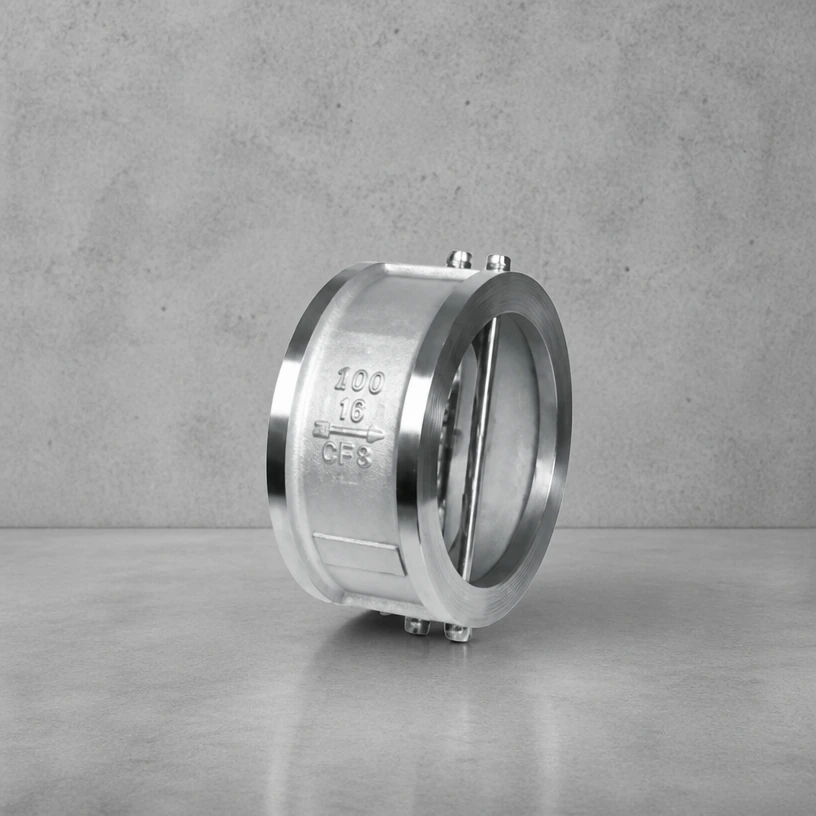
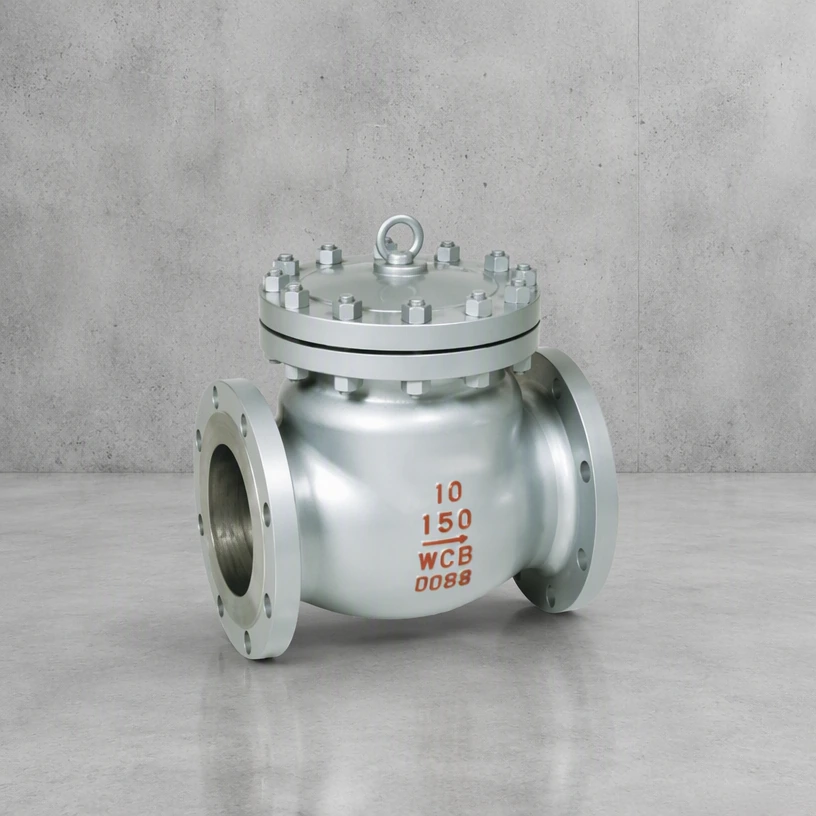
A2. The type is chosen from how much space is available and how fast the flow reverses. A swing check has a hinged disc and is the most common on water and steam mains, but it needs a long installation length and its disc can slam. A dual-plate (wafer) check puts two spring-loaded half discs in a short body, which suits tight spaces and reduces slam. A lift check guides the disc vertically and is used on high-pressure small-bore lines and where the flow is always in one direction. A tilting-disc check is the answer on large compressor and pump discharges, because the disc closes before the flow has fully reversed. Nozzle or axial checks use a spring-loaded ring around the axis and are chosen where the response has to be very fast.
Q3. What should I watch during installation, operation and maintenance?
A3. Orientation rules differ by type and must be followed: a swing check needs a horizontal line with the hinge above the flow, a lift check needs the flow to lift the disc against gravity, and a dual-plate check can go in vertical or horizontal pipe but needs a straight run either side. A check valve is not an isolation valve — it does not replace a gate or ball valve for maintenance, and it should never be the only barrier against reverse flow on a line where backflow would be dangerous. On pumps, fit the check downstream of the isolation valve, not between it and the pump.
Q4. Which standards is this valve designed and tested to?
A4. These valves are built to published standards rather than to a catalogue number. The pressure and temperature framework normally follows ASME B16.34; ASME B16.10 covers face-to-face dimensions and ASME B16.5 the flange drilling. The design reference follows the type: API 600 for bolted-bonnet steel gate, globe and check valves in the larger sizes, API 602 for the compact forged versions, API 608 for ball valves, API 609 for butterfly valves, and API 6D where the valve is intended for pipeline service. Pressure testing follows API 598. The certificate of conformity issued with a delivery states which standard and which revision each item was built and tested to, so the drawing should be read together with that certificate.
Q5. What are the common failure modes, and how are they avoided?
A5. A valve that fails early usually fails for one of four reasons: it was selected on the normal condition and then met the extreme one, it was installed against the flow arrow, it was used for a duty it was never designed for such as throttling or as the sole isolation point, or it was commissioned without the pipework being cleaned. Only the first of those is a selection issue; the other three are found on site, which is why the installation checks matter as much as the specification.
Q6. How do I select the right one for my line?
A6. Work through the operating envelope rather than the normal condition. The normal condition gives the size; the maximum and minimum give the material and the seat. The extremes that matter are the highest temperature, the highest differential the valve will be asked to close against, and the most corrosive or most abrasive the medium will ever be — including during cleaning and start-up, when the fluid is often not what the design assumed. A valve sized on the normal condition alone will be the one that fails first.
Q7. How do I order, and what information is needed for a quotation?
A7. Ordering starts from the line list: tag number, size, class, medium, temperature, connection and operating method. Send that and we will confirm material and seat selection against the medium, flag anything that is likely to cause trouble on site, and quote accordingly. Special sizes, operators and materials are produced to order.