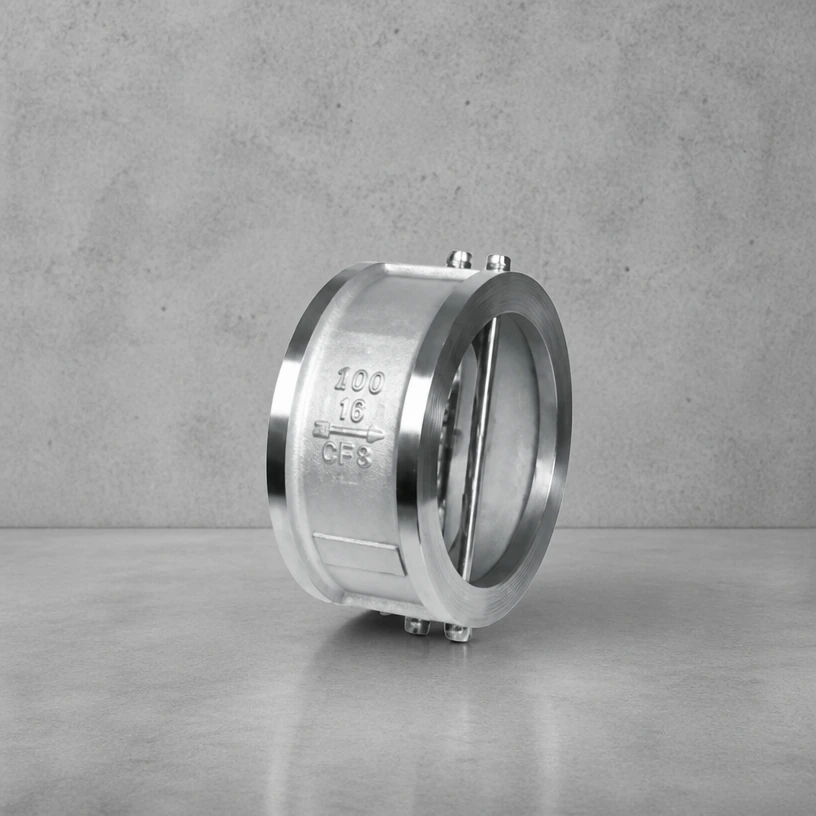
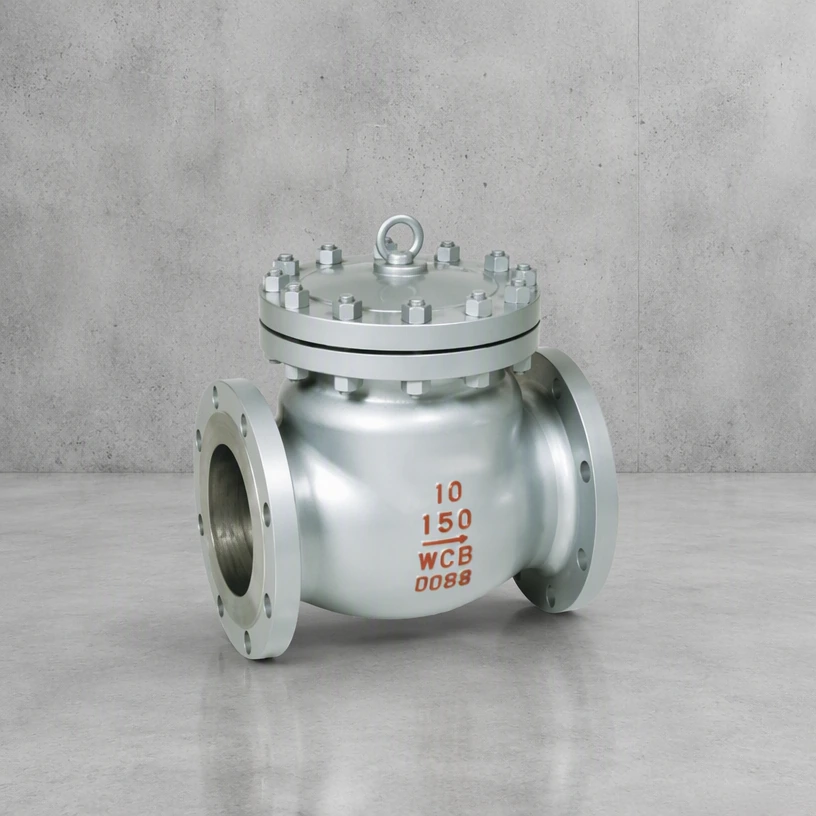
Q1. What is a stainless steel lift type check valve used for, and where is it used?
A1. A check valve prevents reverse flow and does nothing else — it is not an isolating valve and cannot be used to shut a line down. It is fitted wherever backflow would damage equipment, contaminate a line or drain a header: at the discharge of every pump, on compressor and blower outlets, on the suction of a pump fed from a pressurised source, downstream of a meter, at the outlet of a boiler feed line, and on any branch that must not drain back. It works automatically, with no operator and no external signal, so it has to be chosen so that it neither chatters at low flow nor slams when the flow reverses. Because it is a passive item with no adjustment once it is in the line, its closing behaviour is what decides whether it protects the line or damages it. In stainless construction it is used on corrosive and clean services: acids and alkalis, food and pharmaceutical product lines, and demineralised or high-purity water.
Q2. What should I watch during installation, operation and maintenance?
A2. Orientation rules differ by type and must be followed: a swing check needs a horizontal line with the hinge above the flow, a lift check needs the flow to lift the disc against gravity, and a dual-plate check can go in vertical or horizontal pipe but needs a straight run either side. A check valve is not an isolation valve — it does not replace a gate or ball valve for maintenance, and it should never be the only barrier against reverse flow on a line where backflow would be dangerous. On pumps, fit the check downstream of the isolation valve, not between it and the pump.
Q3. How do I choose between austenitic and duplex stainless grades?
A3. Start from the medium rather than from a grade list. CF8 (304 type) is adequate for water, steam and mildly aggressive chemical service; CF8M (316 type) is the usual minimum where chlorides, dilute acids or urea are present. Above roughly 60 °C, chlorides become a stress-corrosion cracking risk for austenitic grades whatever the molybdenum content, and duplex stainless is the standard answer because it resists both cracking and pitting better. Put the medium, its concentration, the chloride level and the temperature into the enquiry — those four figures decide the grade, and a specification that says only ‘stainless steel’ leaves the choice open to whoever quotes it.
Q4. Which standards is this valve designed and tested to?
A4. Where a customer specifies a different standard — DIN, EN, GB or a client specification — it can be worked to, but it should be named at enquiry stage, because it changes dimensions, the material list and the test acceptance at the same time. Two details are worth settling early because they are easy to leave to assumption: the revision of the standard that applies, and which edition of the pressure–temperature tables is being used for the rating.
Q5. How is the valve pressure tested before delivery?
A5. Every valve is shell-tested and seat-tested before dispatch. The shell test is at 1.5 times the rated pressure at 38 °C with the valve partly open, proving the pressure boundary; the seat test is at 1.1 times with the valve closed, proving the closure. Holding time follows the standard and the size. Acceptance is normally quoted against ISO 5208: Rate A means no visible leakage, while lower rates permit a defined leakage over the test period. The rate that applies should be written into the specification — on gas, toxic or metered service Rate A is the usual requirement.
Q6. How do I select the right one for my line?
A6. State the standard you want the valve built to, and the revision, rather than assuming one. A valve can be built to ASME, DIN, EN, GB or a client specification, and the choice changes face-to-face dimensions, flange drilling, the material list and the test acceptance at the same time — so it cannot be settled after the order. Where no standard is named, say which dimension is critical on your line: the face-to-face length where space is tight, or the flange drilling where the valve must bolt up to an existing flange.
Q7. How do I order, and what information is needed for a quotation?
A7. Send the line size, pressure class, medium, working temperature and required connection. Add anything the line demands — sour service, low temperature, a pigging requirement, a control-room signal — and the quotation will come back with the material and seat selection confirmed rather than assumed. Non-standard sizes, alternative operators, trim material and coating can all be produced to order.